2026.02.12
 Industry News
Content
A heavy duty clutch is specifically engineered to handle significantly higher torque loads than standard clutches, typically managing anywhere from 20% to 300% more power transmission capacity. These clutches are critical for vehicles and equipment operating under extreme conditions—towing heavy loads, off-roading, racing, or hauling commercial freight. The fundamental difference lies in construction materials, friction surface area, clamping force, and heat dissipation capabilities that allow sustained performance where standard clutches would quickly fail.
Unlike conventional clutches designed for everyday driving, heavy duty variants incorporate upgraded components such as ceramic or metallic friction materials, reinforced pressure plates with increased clamping force (often 30-50% higher than stock), and strengthened diaphragm springs. For example, a stock diesel truck clutch might handle 400 lb-ft of torque, while a heavy duty replacement can manage 650-800 lb-ft or more, making it indispensable for modified engines or demanding applications.
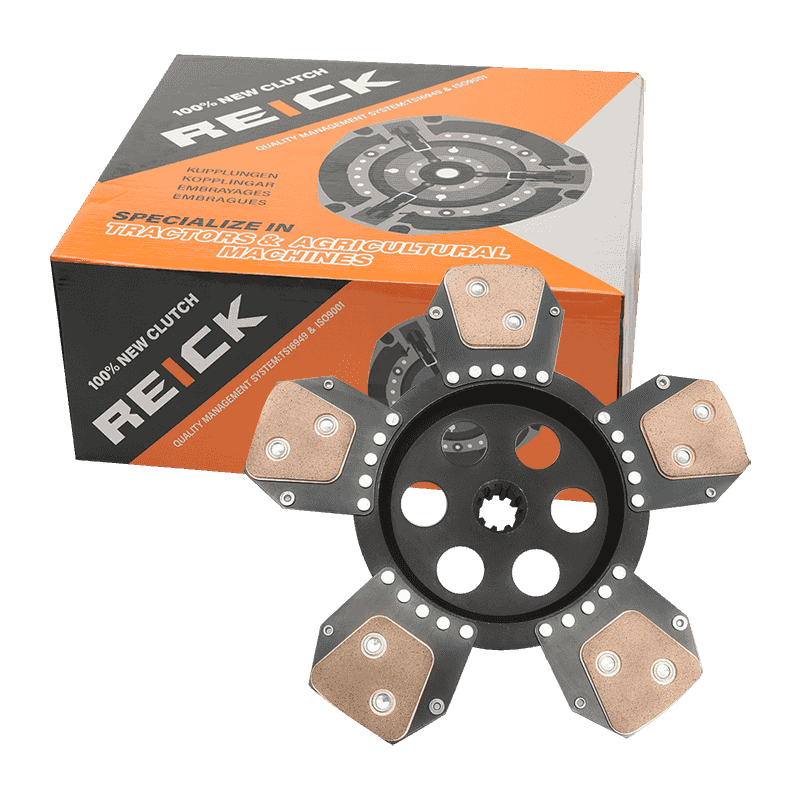
The friction disc in heavy duty clutches features advanced materials that dramatically improve performance. Organic materials are replaced with ceramic composites, Kevlar blends, or sintered metallic compounds that withstand temperatures exceeding 1,200°F without significant degradation. These materials increase the coefficient of friction from standard ratings of 0.35-0.40 to 0.45-0.60, enabling superior torque transfer.
Manufacturers also incorporate sprung hub designs with stronger torsional dampers to absorb drivetrain shock, particularly important in diesel applications where engine pulses create substantial vibration. The disc thickness is often increased from 8mm to 10-12mm, providing greater thermal mass and extended service life.
Heavy duty pressure plates utilize reinforced diaphragm springs or Belleville spring configurations that generate 2,000-3,500 pounds of clamping force compared to 1,200-1,800 pounds in standard units. The cover assembly is typically manufactured from ductile iron or nodular cast iron with increased thickness to prevent warping under sustained high temperatures.
Ventilation is enhanced through strategically placed cooling fins and air channels that promote heat dissipation. Some performance designs feature multi-disc configurations where two or three friction discs share the load, effectively doubling or tripling the contact surface area.
Selecting the appropriate heavy duty clutch requires careful assessment of actual operating conditions. The following table outlines recommended specifications based on common applications:
| Application Type | Torque Capacity Increase | Recommended Material | Pedal Effort Increase |
|---|---|---|---|
| Daily Towing (10,000-15,000 lbs) | 30-50% | Organic/Kevlar | 10-20% |
| Commercial Hauling | 60-100% | Ceramic Composite | 25-35% |
| Performance/Racing | 100-200% | Sintered Metal/Puck | 40-60% |
| Off-Road/Rock Crawling | 50-80% | Kevlar/Ceramic Blend | 20-30% |
When engines are modified for increased power output, clutch capacity must scale accordingly. A common guideline is to select a clutch rated for at least 25% above your maximum torque output to provide safety margin. For turbocharged or supercharged applications, this margin should increase to 35-40% due to torque spikes during boost conditions.
Real-world example: A 6.7L Cummins diesel tuned from 370 HP to 550 HP sees torque increase from 850 lb-ft to approximately 1,200 lb-ft. The appropriate heavy duty clutch should be rated for minimum 1,500 lb-ft capacity to ensure longevity and prevent slippage under full load conditions.
Heavy duty clutches deliver quantifiable benefits across multiple performance metrics:
The enhanced capability comes with specific trade-offs that operators must accept. Pedal effort increases proportionally with clamping force—a clutch rated 100% over stock may require 50-60% more leg pressure, which can cause fatigue in stop-and-go traffic. This is particularly noticeable for drivers transitioning from hydraulic-assisted systems.
Engagement characteristics also change. Aggressive friction materials like puck-style or sintered metal discs create an on/off engagement feel rather than the progressive modulation of organic materials. This makes smooth launches more challenging and may induce driveline shock if not operated skillfully. Additionally, ceramic and metallic compounds often produce audible chatter or squeal during low-speed maneuvering, which is normal but may be perceived as objectionable by some users.
Proper installation is essential for achieving rated performance and longevity. The following procedures must be observed:
Not all heavy duty clutches are compatible with existing flywheels or hydraulic systems. Dual-mass flywheels may require conversion to single-mass when upgrading to aggressive clutch materials. Hydraulic throw-out bearings must be verified for adequate travel distance—some heavy duty pressure plates require 15-20mm additional travel compared to stock, potentially necessitating master cylinder upgrades.
Transmission input shaft spline count and diameter must match the clutch disc hub. Common configurations include 10-spline (1-1/8" or 1-1/16") and 23-spline (1" diameter) for diesel applications. Mixing incompatible components results in immediate failure or dangerous slippage.
Even heavy duty clutches deteriorate rapidly under abusive operation. The following practices maximize component lifespan:
Monitor these symptoms to identify developing problems before catastrophic failure:
Professional inspection is recommended when any of these symptoms appear. Continuing operation with a compromised clutch risks transmission damage, flywheel destruction, or catastrophic failure that leaves the vehicle stranded. The average cost of addressing symptoms early is $800-1,500, while delayed intervention often escalates to $2,500-4,000 when secondary components are damaged.
Heavy duty clutch kits typically cost $600-2,000 compared to $250-600 for OEM replacements, representing a 2-4x price premium. However, when analyzed over the component lifespan, the economics favor upgraded systems in demanding applications. A standard clutch requiring replacement every 60,000 miles in towing service results in 3-4 replacements over 200,000 miles at $400 each ($1,200-1,600), plus labor costs of $500-800 per installation ($1,500-3,200 total labor).
A heavy duty clutch lasting 180,000-200,000 miles requires only one installation at $1,200 for parts and $600-800 for labor. Total cost over 200,000 miles: $1,800-2,000 versus $2,700-4,800 for repeated standard clutch replacements. The breakeven occurs at approximately 90,000-100,000 miles, with downtime reduction providing additional value.
For commercial operators, downtime represents the most significant cost factor. Each clutch replacement requires 6-10 hours of shop time plus vehicle unavailability. At typical commercial rates of $150-200 per operational hour lost, a single replacement costs $900-2,000 in lost productivity beyond parts and labor. Heavy duty clutches that eliminate 2-3 replacement cycles save $1,800-6,000 in opportunity costs alone, making them economically mandatory rather than optional for fleet operations.
Recommended Products


+86-139 6193 3287
+86-515-88410559

+86-515-88580498

reickchina@reickparts.com

B1002 Huabang Dong No.1# South Renmin Road, Tinghu District, Yancheng City, Jiangsu, China
Copyright © 2024 Yancheng Reick Automotive Parts Co., Ltd. All Rights Reserved.
Automotive Brake Manufacturers Automotive Clutch Parts Suppliers



 English
 Español
 italiano