Home / News / Industry News / Clutch Kits, Clutch Disc & Clutch Cover: What They Do and How to Choose
 2026.05.26
 Industry News
Content
A clutch failure rarely announces itself in advance. One day the pedal feels slightly soft; a week later, gears slip under load and the vehicle barely moves. The root cause almost always traces back to three components: the clutch disc, the clutch cover (pressure plate assembly), and how they work together as a matched system — which is exactly what a clutch kit delivers.
The clutch disc sits between the flywheel and the pressure plate. Splined to the transmission input shaft, it is the only friction element that transfers engine torque to the drivetrain. Its facing material — organic, ceramic, or semi-metallic — determines heat tolerance, engagement smoothness, and service life. A ceramic-pad disc, for example, handles high clamping forces and elevated temperatures that would glaze an organic facing within weeks.
The clutch cover is the pressure plate assembly: a spring-loaded housing bolted to the flywheel that clamps the disc in place when the pedal is released and pulls away when the pedal is depressed. Diaphragm-spring covers are standard on passenger cars because they maintain consistent pedal effort as the disc wears. Lever-type covers appear on large commercial vehicles where push- or pull-release geometry suits the drivetrain layout.
A clutch kit bundles disc, cover, and release bearing — sometimes a pilot bushing and alignment tool — into a single matched set. Because every component reaches the end of its useful life at roughly the same mileage, replacing them together during one labour-intensive teardown saves both money and downtime.
Sourcing a disc from one supplier and a cover from another introduces dimensional risk. Cover diameters, spring rates, and friction surface profiles are engineered as a unit. A mismatched set can produce chatter on engagement, premature facing wear, or incomplete disengagement that damages the transmission over time.
Consider Reick's 826634 Clutch Kit engineered for Citroën Berlingo, Fiat Scudo, and Peugeot 308: the cover measures φ230 × φ154 × φ254 mm and pairs with a disc of φ229 × φ155 × 18 mm — dimensions developed together so clamping force distributes evenly across the friction surface. Using only 100% new components (never rebuilt parts) and built to OE specification, this kit exemplifies the precision a matched system offers.
| Parameter | Specification |
|---|---|
| Clutch Cover Size | φ230 × φ154 × φ254 mm |
| Clutch Disc Size | φ229 × φ155 × 18 mm |
| Compatible Vehicles | Citroën Berlingo, Fiat Scudo, Peugeot 308 |
| Component Condition | 100% new, not rebuilt |
| Quality Standard | OE specification / IATF 16949 |
Passenger car clutch kits share little engineering DNA with those designed for commercial trucks or agricultural equipment. A heavy-duty application demands far higher torque capacity, resistance to heat soak from sustained slip, and a cover design that survives thousands of load cycles without spring fatigue.
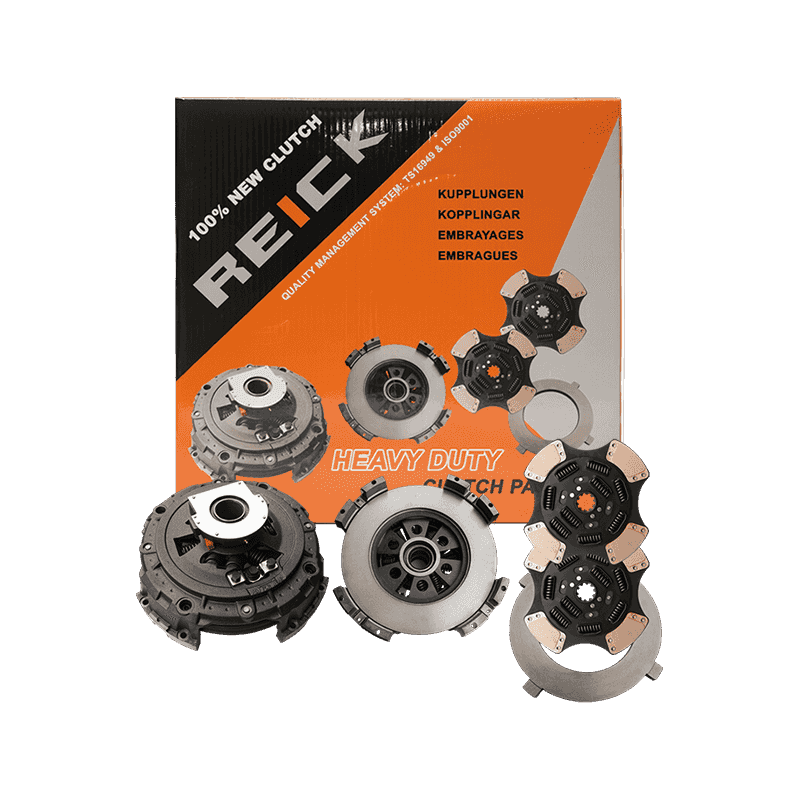
Reick's American truck clutch kit 108935-51 for MACK illustrates this clearly: a 15½-inch diameter (393 mm) disc with ceramic 4-pad facing, 9 springs, and a rated torque capacity of 1,760 ft-lb. Ceramic pads maintain friction coefficient at temperatures that would cause organic material to fade — critical when a loaded truck is downshifting on a long grade. The kit is also designed to be maintenance-free and adjustment-free after installation, cutting fleet service costs significantly.
For agricultural and tractor clutch applications, the priorities shift again toward torque multiplication at low RPM and tolerance for the shock loading common in field work — factors that influence both disc damper spring design and cover clamp-load calibration.
Three questions narrow the decision quickly:
A slipping clutch — where engine RPM rises without a corresponding increase in vehicle speed — means the disc facing has worn past its minimum thickness or become glazed. Shudder on engagement usually points to contaminated facings (oil or coolant) or a warped flywheel surface. A dragging clutch, where gears grind even with the pedal fully depressed, often indicates a failed release bearing or a disc that has seized on the input shaft spline.
Any of these symptoms warrants inspection of the complete passenger car clutch assembly, not just the most obviously worn part. Given that clutch labour — removing the gearbox to access the assembly — accounts for the majority of replacement cost, replacing only the disc and leaving a fatigued cover in place is rarely economical.
The standard recommendation from most drivetrain engineers is to replace all three core components simultaneously: disc, cover, and release bearing. The reasoning is simple. All three experience the same heat cycles, the same clamping forces, and the same wear rate over the vehicle's life. A new disc pressed against a cover whose diaphragm springs have weakened will not transmit full torque — the system is only as strong as its most fatigued component.
For vehicles serving 50+ countries across Europe, North America, and Southeast Asia — the markets Reick's full clutch system product range is designed for — consistent OE-specification kits reduce warranty claims, speed installation, and give technicians confidence that every component has been engineered to work together from day one.
Recommended Products


+86-139 6193 3287
+86-515-88410559

+86-515-88580498

reickchina@reickparts.com

B1002 Huabang Dong No.1# South Renmin Road, Tinghu District, Yancheng City, Jiangsu, China
Copyright © 2024 Yancheng Reick Automotive Parts Co., Ltd. All Rights Reserved.
Automotive Brake Manufacturers Automotive Clutch Parts Suppliers



 English
 Español
 italiano