Home / News / Industry News / What Is a Rotor on a Car? Brake Disc Function, Wear Limits and Fitment Checks
 2026.11.25
 Industry News
Content
A rotor on a car is the cast-iron disc that the wheel spins and the brake pads clamp. It bolts to the wheel hub, turns at wheel speed, and provides the friction surface that converts motion into heat. Most modern passenger cars carry four of them, one inside each wheel, and the front pair does most of the work. The details below cover what the part does, how it is specified, when it is genuinely worn out, and what to check before a replacement goes on the shelf.
The rotor does three jobs at once: friction surface, heat sink, and mounting face for the wheel.
A 1,500 kg car at 100 km/h holds roughly 580 kJ of kinetic energy, and on a hard stop almost all of it has to leave through four rotors as heat. A 300 mm vented front rotor weighs about 7 to 9 kg in grey cast iron, and that mass is the buffer that keeps pad temperature away from fade on a long descent.
That last point matters on the parts counter. Two rotors that look identical from a metre away can differ in hat height, tone ring tooth count, or whether a bearing is pressed in, and those differences decide whether the part fits at all.
Rotor is a broad engineering word, and on a car it can point to four different parts depending on who is speaking.
| Brake rotor, or brake disc | The disc the pads clamp; the friction surface of a disc brake. This is the default meaning. |
| Brake drum | A different system entirely: a cast housing that brake shoes press outward against. |
| Wheel hub | The bearing assembly the rotor bolts onto. Hub and rotor are separate parts. |
| Distributor rotor | An ignition part inside older petrol distributors that routes the spark. Unrelated to braking. |
| Motor rotor | The spinning inner part of an electric traction motor, turning electrical energy into torque. |
Most front rotors are vented, most rear rotors on compact cars are solid, and drilled or slotted discs are a performance and appearance choice rather than a default.
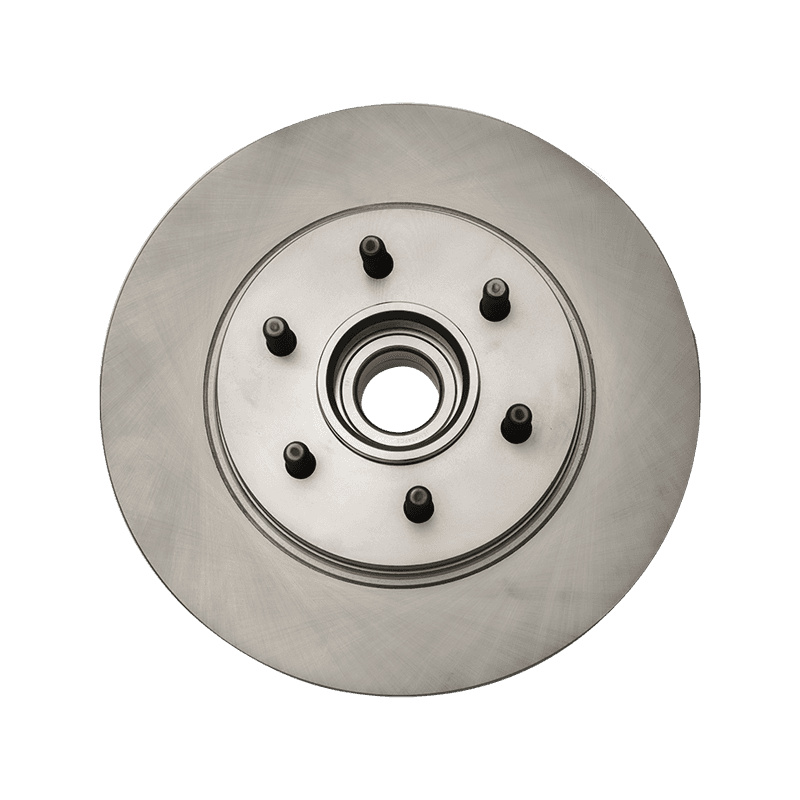 REICK Brake Disc and Rotor RangeBrowse REICK brake discs and rotors for Hyundai/Kia and Ford F-150 applications, including solid and performance-style drilled or slotted options.View Product →
A rotor is finished when it reaches its minimum thickness, exceeds its runout or thickness variation limit, or shows cracking and deep scoring. Anything else is a judgement call rather than a rule.
| Application | Nominal thickness | Typical minimum | Allowance |
| Front vented, compact car | 24 mm | 22 mm | 2 mm |
| Front vented, SUV or performance | 30-32 mm | 27-28 mm | 3-4 mm |
| Rear solid, passenger car | 10-12 mm | 8-9 mm | 2 mm |
| Rear vented, heavy car | 18-20 mm | 16-17 mm | 2-3 mm |
Five attributes decide whether a rotor fits: diameter, nominal thickness, overall height, bolt pattern and vent type. Get any one of them wrong and the part comes back.
REICK produces brake discs and rotors alongside pads, shoes and linings, with dimensional inspection on every batch and process control under ISO/TS16949; the quality and testing process sets out the checks. Matching an OEM number is a matter of confirming thickness, height and vent style against the drawing before the carton is sealed.
 58411-1H100 Rear Solid Brake Rotor for Hyundai and KiaRear solid rotor for Sonata, K5 and Sportage with 10 mm max thickness, 5 holes and 61.1 mm height; an OEM-number-specific fit.View Product →
Yes. Rotor is the common American term and disc the common British one, and both describe the same part on a disc-brake car. Catalogues usually list it as brake disc and rotor so that either search finds the number.
Most rotors survive one to two sets of pads, roughly 50,000 to 120,000 km of mixed driving. Short trips, heavy loads and hilly routes shorten that considerably, so a measurement at every pad change beats any mileage figure.
No. Machining is only an option when the disc is above minimum thickness and runout or surface damage justifies it. Many coated rotors should not be turned at all, because the coating is the corrosion protection for the hat and vanes.
Usually uneven wheel nut torque, rust or debris left on the hub face, or pads that were never bedded in. Clean the hub, torque in a star pattern and recheck runout before blaming the rotor.
Recommended Products


+86-139 6193 3287
+86-515-88410559

+86-515-88580498

reickchina@reickparts.com

B1002 Huabang Dong No.1# South Renmin Road, Tinghu District, Yancheng City, Jiangsu, China
Copyright © 2024 Yancheng Reick Automotive Parts Co., Ltd. All Rights Reserved.
Automotive Brake Manufacturers Automotive Clutch Parts Suppliers



 English
 Español
 italiano