Home / News / Industry News / What Is Brake Fluid? How Hydraulic Braking Works and When to Replace It
 2026.09.23
 Industry News
Content
A pedal that feels spongy on a Monday morning, a reservoir sitting just under the MIN mark, and a top-up that fixes nothing for more than a week: that is where most brake fluid conversations start. The short answer to what brake fluid is comes down to one job — it is the hydraulic liquid that carries force from the pedal to the brakes at every wheel, and it is the only fluid in the car that has to stay incompressible while regularly seeing temperatures above 200 °C.
Once you know that brake fluid is hygroscopic, meaning it absorbs water through hoses, seal lips and the vented reservoir cap, the rest of the maintenance story follows. Water lowers the boiling point, a lower boiling point lets vapour form inside a caliper under hard use, and vapour is compressible, which is why a firm pedal can travel to the floor after a long descent. Choose the rating the vehicle maker specifies, test for moisture at every service, and replace the fluid on time rather than on mileage.
A brake system is a sealed hydraulic circuit. Pressing the pedal moves a pushrod that drives the master cylinder piston, which pushes fluid through rigid lines and flexible hoses to caliper pistons or wheel cylinders. Because liquid is very nearly incompressible, the pressure created at the master cylinder appears almost instantly at every wheel.
The scale of that pressure is what makes the fluid's job demanding. A 400 N push on the rod of a 25 mm master cylinder piston produces roughly 8 bar of line pressure, and that pressure acts on caliper pistons with a much larger surface area, multiplying clamping force at the pad. The whole system is engineered around a fixed fluid volume, so a few millilitres of loss or one small air bubble changes pedal travel immediately.
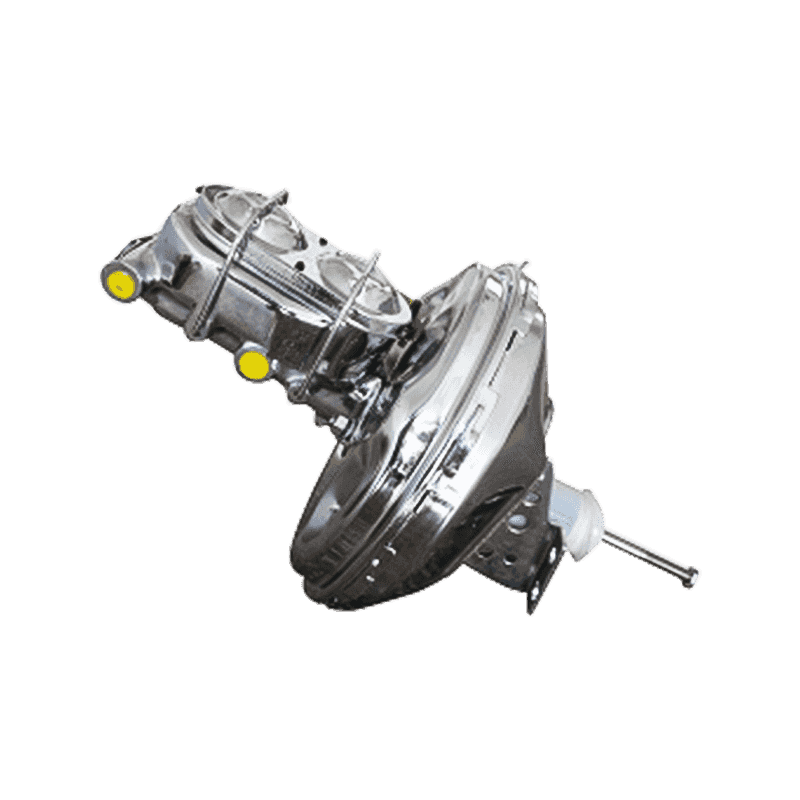 PB11003C Brake Booster with brake master cylinder, chrome• Confortable driving. • Long service life. • Wide range of models are available. • Easier for drivers to push the brake pedal.View Product →
On many manual-transmission cars the same fluid also operates the clutch release mechanism through a master and slave cylinder, which is why one reservoir can sit above both the brake and clutch circuits.
Almost any liquid will transmit pressure. Brake fluid has to hold four properties at once, and in practice they pull against each other:
The letters come from the US Department of Transportation, which sets minimum performance through FMVSS 116; SAE J1703 and J1704 and ISO 4925 cover similar ground for other markets. The rating says nothing about brand quality. It describes a chemistry and a set of minimum numbers, of which boiling point and viscosity matter most in service.
| Rating | Base chemistry | Dry boiling point | Wet boiling point | Where you meet it |
|---|---|---|---|---|
| DOT 3 | Glycol ether | 205 °C / 401 °F | 140 °C / 284 °F | Older and economy vehicles |
| DOT 4 | Glycol ether with borate esters | 230 °C / 446 °F | 155 °C / 311 °F | Most European and many Asian cars |
| DOT 4 LV | Low-viscosity glycol ether | 230 °C / 446 °F | 155 °C / 311 °F | ABS, ESP and cold-climate use |
| DOT 5.1 | Borate-based glycol ether | 260 °C / 500 °F | 180 °C / 356 °F | Performance and heavy braking |
| DOT 5 | Silicone | 260 °C / 500 °F | 180 °C / 356 °F | Specialist and vintage applications |
Two warnings are worth repeating to any customer. DOT 5 is silicone based and must never be mixed with glycol fluid or poured into a system designed for it, because the two do not blend and silicone can aerate in ABS hardware. Separately, a higher rating is not automatically better: DOT 5.1 offers more boiling point margin than DOT 4, but it also absorbs moisture faster, so a daily driver that never sees hard use gains little from it.
Glycol fluid is hygroscopic by design. It pulls moisture from the air through flexible hoses, seal lips and the vented reservoir cap, and it keeps that water dispersed rather than pooled in one spot. The cost is a steady drop in boiling point: a DOT 4 fluid rated at 230 °C dry falls to its 155 °C wet rating after absorbing roughly 3.7 percent water, a level that two to three years of normal driving in a humid climate can reach.
Under repeated hard braking — a long mountain descent, a loaded van, a track session — a caliper can exceed that wet figure. Vapour forms, the pedal goes long or drops to the floor, and no warning light comes on beforehand. Water also corrodes from the inside out: master cylinder bores pit, steel lines rust, and the debris can make caliper pistons stick. Fluid colour is a rough guide, since fresh glycol fluid is clear to light amber while dark brown or black fluid usually carries corrosion products and rubber particles.
Do not simply top up and move on. If the level falls with no external leak, the rear seal of the master cylinder may be pushing fluid into the vacuum booster. That fluid destroys the booster's internal diaphragm over time, and the two parts are normally replaced together.
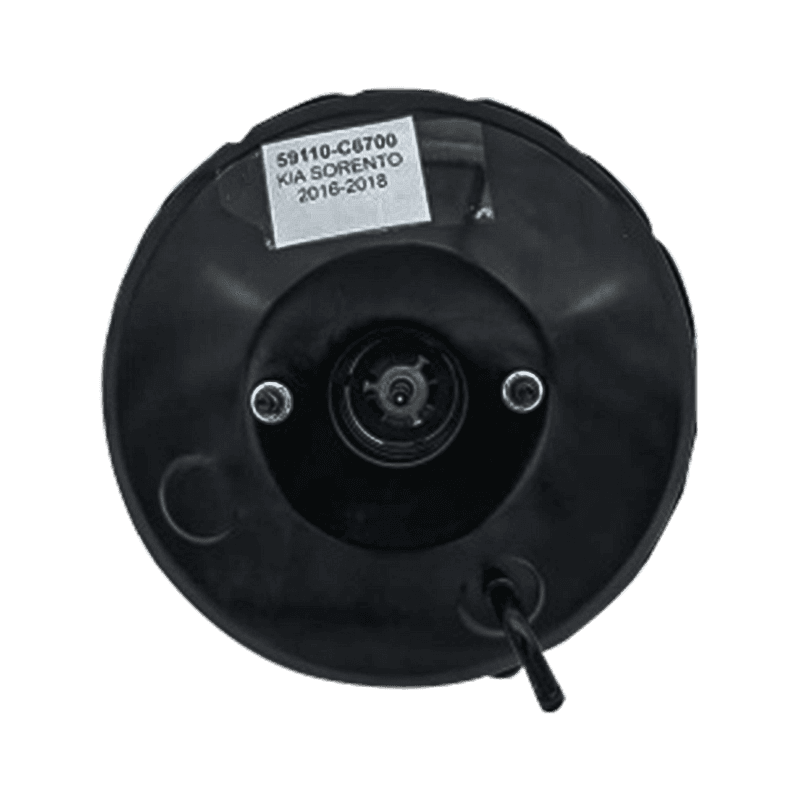 59110-C6700 Power Brake Booster for HYUNDAI and KIA SORENTO 76-78• Easy intallation. • Fast response, stop quickly improved Safety. • Original Specification. • Efficient Braking SystemsView Product →
Glycol brake fluid is replaced on time, not on mileage. Most manufacturers call for a change every 24 months, and sooner where the vehicle is driven hard, lives in a humid climate or does short stop-start duty cycles.
Two rules prevent expensive mistakes: never mix silicone DOT 5 with glycol fluid, and never let a petroleum-based product near the system, because mineral oil swells and destroys the rubber seals within hours. Spilled fluid also strips paint, so rinse any contact area with water. On common daily drivers, semi-metallic friction handles the mechanical side of the job while the fluid handles the hydraulic side, and matching both to the vehicle specification keeps pedal feel consistent between visits.
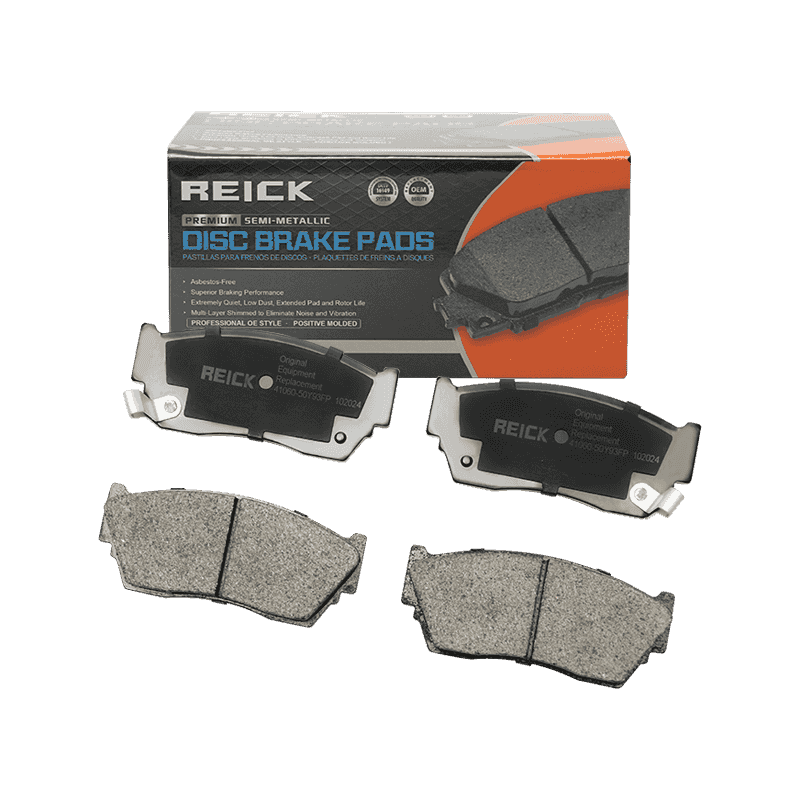
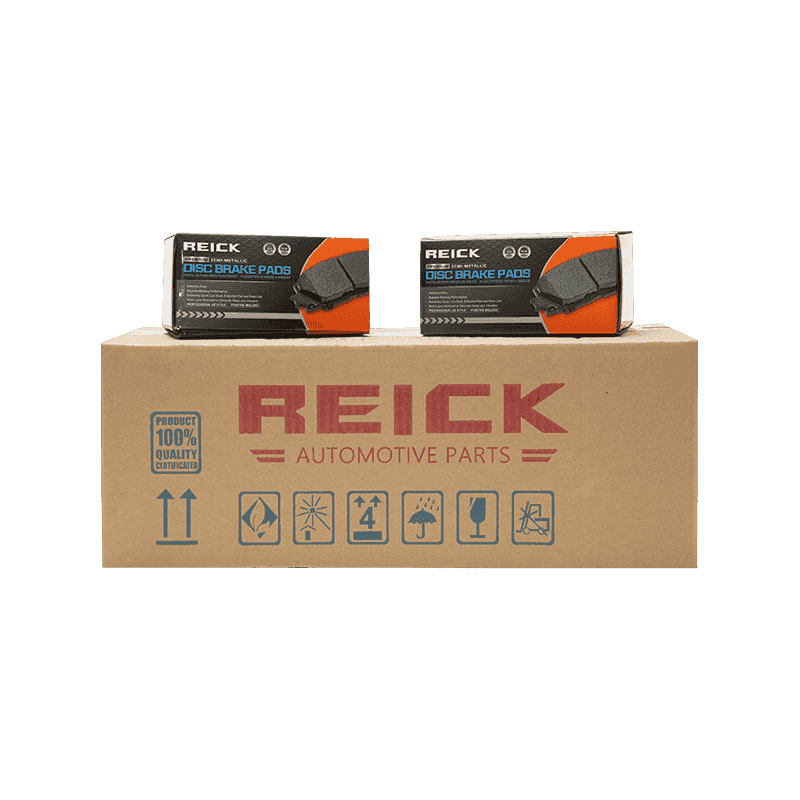 41080-1HL0A Semi- metallic brake pad used for DONGFENG, NISSAN Yaris• Low dust and increased rotor life. • 100% Asbestos free formulation. • Powder coated backing plates. • Positive mold care press technology.View Product →
For anyone stocking or servicing brakes, brake fluid is the specification-driven item in the programme. There are only a handful of ratings, but the cost of getting them wrong is high: the wrong chemistry damages seals, and an under-specified fluid gives away boiling point margin that a loaded truck or a track-day car will use up in a single afternoon.
Hydraulic parts usually follow a fluid service. Master cylinders, boosters, calipers, wheel cylinders, discs and pads all sit in the same repair, and matching them by OEM number and vehicle application keeps the job predictable. REICK manufactures braking and clutch system parts for passenger cars, commercial vehicles and tractors, working to ISO 9001 and ISO/TS 16949 and to ECE R90 for friction products, with ceramic, low-metal and semi-metallic ranges. The brake pad range covers the friction side of that programme, and the guide to how a complete braking system works explains the hydraulic layout behind it.
Brake fluid is easiest to understand as the volume that never changes. Keep it clean, keep it dry and keep the specified rating in the reservoir, and the pedal stays where the engineers intended. Let moisture in, and the same fluid that stops the car reliably at city speeds can turn to vapour on the one descent where you need it most.
Recommended Products


+86-139 6193 3287
+86-515-88410559

+86-515-88580498

reickchina@reickparts.com

B1002 Huabang Dong No.1# South Renmin Road, Tinghu District, Yancheng City, Jiangsu, China
Copyright © 2024 Yancheng Reick Automotive Parts Co., Ltd. All Rights Reserved.
Automotive Brake Manufacturers Automotive Clutch Parts Suppliers



 English
 Español
 italiano